Showing posts with label Scooter. Show all posts

Thursday, January 14, 2010

End of the Road for Bajaj Scooters - http://www.financialexpress.com/news/how-marketing-myopia-can-spell-trouble-for-business/564148/1


Bajaj Auto announced that it was discontinuing the production of scooters. As quoted in a newspaper, the managing director reportedly said, “one day, God willing, we will be the largest motorcycle company in the world. If we have to be a motorcycle specialist, we have to make a sacrifice in the scooter segment—where we are not selling according to expectations.”
Consider the facts. According to Siam, Bajaj’s cumulative domestic scooter sales during April to November 2009 was 3,356 units, a decline from a similar period the previous year. The Indian scooter market, currently at 1.2 million, is growing at 15%. From 12% of two wheelers in 2008, scooters are expected to contribute 20% to two-wheeler sales in 2010. The scooter market has grown at double digits in the last fiscal compared to the motorcycle market, which grew only at 2.6%. Honda Motorcycle and Scooter India has just started a third assembly line at its plant to meet growing demand for scooters.
It would appear that the venerable Bajaj brand is falling into a classic trap of marketing myopia. Almost 50 years ago, the late Ted Levitt coined the term ‘marketing myopia’ for a firm or manager’s approach and thinking that is product-focused. He suggested that the reason railroad companies in the US declined in the early- and mid-20th century was that they thought they were in the railroad business—not the transportation business; they thought that customers were buying ‘railroad’ services from them—not the benefit of being transported from point A to point B in a convenient, inexpensive way. The railroads got into trouble not because the need for passenger and freight transportation declined. That grew. However, that need was filled by others (cars, trucks, airplanes, even telephones); it was not filled by the railroads themselves.

In a similar fashion, Hollywood barely escaped being totally ravished by television. Actually, all the established film companies went through drastic reorganisations. Some simply disappeared. All of them got into trouble not because TV’s inroads hurt but because of their own myopia. As with the railroads, Hollywood defined its business incorrectly. Studios thought they were in the movie business when they were actually in the entertainment business. ‘Movies’ implied a specific, limited product. This produced a fatuous contentment which from the beginning led producers to view TV as a threat. Hollywood scorned and rejected TV when it should have welcomed it as an opportunity—an opportunity to expand the entertainment business. TV grew into a bigger business than the old narrowly defined movie business ever was. Had Hollywood been customer-oriented (providing entertainment), rather than product-oriented (making movies), it would not have gone through the financial, market and emotional purgatory that it did.

In both railroads and Hollywood, the efforts focused on improving the efficiency of making the product and on making a better product—not really on understanding what the customer was looking for and in developing and executing a good product and marketing plan. Moreover, the firms in the industry defined their products in the narrowest possible terms—just as Bajaj Auto today appears to be defining itself as being in the motorcycle business and becoming a motorcycle specialist.
It would appear that Bajaj Auto is falling into a similar trap that railroad firms and Hollywood studios fell into in the early 20th century. Mahindra & Mahindra had launched two scooter models, Rodeo and Duro, in September 2009, which are reportedly selling at more than 7,000 scooters a month. And Bajaj Auto cannot sell even 200 scooters a month? Looks like one or more of the following is true. Someone there is simply not looking at the data from the market. Or the company or at least many influential people in the company think that it is in the motorcycle business.
Let us be very clear. Bajaj Auto is ‘not’ in the motorcycle business. Bajaj Auto (and Hero Honda, TVS, HMSI, Suzuki Motors, Hyundai etc) is actually in the business of providing commuting services to office goers; it is in the business of providing a thrill and ego boost to young males; it is in the business of providing (young) family transportation; it is in the business of providing stage and contract carriage; it is in the business of providing status and transportation to college going teenagers etc. The motorcycle simply happens to be one current form of a product that satisfies some of the above enumerated needs.

As an Indian, I am enormously proud of the fact that Bajaj Auto today has morphed into an Indian company that has some of the best two wheeler technology in the world, that it has developed on its own—its DTSi engines give more than any other comparable engines and are the best in the class. It is sad to see a company that has such a business-savvy lineage making marketing decisions that leave so much money on the table for competitors. At the very least, it appears that a company that was the leader in the market across segments is now on its way to confining itself to the higher-end segments—a sure shot way of becoming a niche player or of long-term decline.
The author is a professor at IIM, Ahmedabad. These are his personal views...

Sunday, December 27, 2009

Vintage Scooters and Mopeds - Pune Mirror


Make way for the Lambrettas, Vespas, Javas, Yezdis, Aerials and Nortons.

These vintage bikes and scooters are back in demand in Bangalore following a huge demand for them in the West. Such two-wheelers, which until recently only had scrap value, are now being sold for anything from Rs 40,000 to Rs 75,000. Ads for these vehicles are flooding the internet.


Sudhakar, a 32-year-old resident of Ulsoor and a collector of these vintage bikes, explains that the demand for these vintage two-wheelers is something new and exciting for Bangaloreans.

Now, with some of these vehicles being valued close to Rs 1 lakh, Sudhakar’s excitement is quite understandable. His fascination for these vehicles dates back to his college days. He used to get these old scooters painted attractively and turn heads in college to counter the rich guys who would ride the latest bikes.

 After buying a Lambretta scooter for Rs 30,000, Sudhakar spent close to Rs 15,000 for painting and spares. He now plans to sell it for Rs 60,000. Except for tyres, nothing is Indian in his scooter. “Though it is bulky to push and pull, once you kick off, it is almost like flying in the air,” he adds. He says the company has reopened in the West and is buying all the models. Sudhakar plans to sell his 1972 Lambretta Roller, made in England.

Sudhakar is not the only one. Nazeer Ahmed is also among those Bangaloreans cashing in on this new-found love for vintage bikes and scooters. This resident of Kodandaramanagar near Pulikeshinagar (Frazer Town) recently sold his Norton 500 cc to a German automobile showroom. He is now ready to sell his 40-year-old 48 cc Italian made Lambretta Moped. “I bought it (moped) for Rs 2,000 nearly 28 years ago. The first bike I got was when I was 12 years old. As we ran our own workshop and iron fabrication industry, my inclination towards these bikes was natural. A few months ago, I was told that there has been a great demand in Germany for these mopeds, which were so widely used during World War II.

Some showroom owners bought it and today they have displayed it in their showroom. Nobody but me touched that bike,” claims Nazeer. He uses his single-seater 1960 Lambretta Moped occasionally. Even today, its mileage is 45-50 km per litre and it can reach a top speed of 70 kmph. It can be compared to the present day Hero Puch. Unlike Puch, it does not have a kick start but can be started by pedalling.

Friday, December 25, 2009

Scooters for girls - Harriet Ridley

Scooters for girls

While there are plenty of Vespas built for anyone who wants to ride one, man or woman (the Vespa GTS 125 and 300 Super caught my eye in Milan), the Vespa Rosa introduced to the UK last Spring, to name just one of them, is clearly designed for girls with its very pink colour scheme. A man would, as I wrote, have to be seriously in touch with his feminine side to ride one of these. Not that there's anything wrong with that!


But apparently, I'm propagating a sexist myth here in the UK that all scooters, and Vespas in particular, are girls' bikes. I don't believe that for a second. Open any scooter brochure and it's still mostly male models riding the bikes, Vespas included - although perhaps not the Rosa. And overall in the UK, there are still far fewer women than men riding scooters.
However, the best thing about scooters is the lack of male-domination that still pervades the motorcycling world. In fact the UK's scooter boom that kicked off around 1997 has been responsible for a huge surge in girls getting on two wheels.
Scooters are so unisex that manufacturers are going as far as bringing out 'his and her' colour schemes of the same model, as the array of new bikes at this year's EICMA Milan show demonstrates.
Kymco for instance displayed the Many 50 and 100 in two colour schemes: white and incrusted with (no doubt fake) diamonds for her, and a sportier red paintjob for him.
Meanwhile on one of its models, Motom brought out the Lambretta 'Rubacuori' (that's Italian for heartbreaker) complete with pink paintjob littered in hearts and a cupid with bow and arrow for her, while a manlier pirate-style paintjob features on the 'Black' for him. Both versions are available as 50cc, 125cc or 150cc.
I guess it's unfair for the boys that the girls can ride, for instance, the red Many without attracting attention for all the wrong reasons. Meanwhile, blokes risk getting laughed at by their beered-up mates should they venture down the pub on the sparkly girly version.
But that's life. Girls wear trousers all the time; blokes only wear skirts if they're Scottish or David Beckham. Or seriously in touch with their feminine side.
There are also the less in-your-face, more tasteful colour schemes still obviously targeted to women. For instance Suzuki's white Sixteen 150 with its stylish flowery detailing. Or the Suzuki Burgman 200 with its soft curves and pearlescent colour scheme (oh I'm sorry, is this not meant to be girly?).
Don't get me wrong. Not all girls want to ride a sickly sweet pink scooter with hearts, diamonds or even the more subtle flowery detailing. Give me a sporty job such as the Aprilia Sport City, Gilera Runner or even better, the GP800 any day. Or even a cushty Suzuki Burgman 650 - have you seen the 2010 version? It looks unbelievably comfortable with its heated armchair-style seat and grips.
Even the new Burgman 400 with its fancy ABS is commuter heaven enough for me. But there's nothing wrong with women flouting their girliness should they wish to. And the option for them to do so is there.
However, the manufacturers say many of the overtly girly colour options, for instance the Piaggio Liberty Elle with its matching pink and flowery open-faced helmet and top box, won't be imported to the UK because there isn't enough demand.
I reckon this has more to do with us British girls having good taste in scooters than there not being enough of us. Still, no matter how dreadful some of these colour schemes truly are - the Scarabeo's bubble-gum pink paintjob is not really my thing (who am I kidding, I love it!) - it's encouraging to see manufacturers sit up and take note of us girls on bikes.

MERRY CHRISTMAS !!

Thursday, December 24, 2009

The Bajaj Chetak Nostalgia - Pune Mirror,Pune Mirror


It’s interesting that all this nostalgia is spilling now, a few years after the Chetak was discontinued, simply because Rajiv Bajaj chose to make a big deal about the demise of the uninspired Kristal. It almost seems like the whole brouhaha was calculated to spite his father. No one will really miss the Kristal, but the decision is important on a symbolic level, and it seems strange to absolutely rule out future scooter production. Which makes me even more positive that a retro Chetak is imminent, ha. Then again, LML has that market pretty well covered now. - 2strokebuzz


Son rise , News - Latest - Pune Mirror,Pune Mirror

Finally, the generation gap has caught up with Rahul Bajaj! The two-wheeler giant Bajaj Auto will now stop making scooters, and the old man is not happy with his son and Managing Director Rajiv Bajaj’s decision to exit production of scooters.

It is the end of an era and the demise of a philosophy: that two-wheelers were meant to move from point A to B. Today, it is the age of the fast bikes. And our inhouse expert agrees with the company’s new ideology.

Group chairman and Rajiv’s father, Rahul Bajaj has made his feelings clear about the scooters’ forthcoming demise. “I feel bad, I feel hurt.

I can’t say harm the company and its shareholders by doing something you should not do... But I am still not convinced. He [Rajiv] has tried to explain it to me,” were his exact words.

However, the young MD rebuffed the emotional outburst by saying: “I care less for the solution from emotions, I believe more in the magic of logic.

Brands that are more sharply positioned are brands that are more profitable... It [scooter] is not a really profitable market.”

For an expert’s opinion on this situation, Pune Mirror talked to Adil Jal Darukhanawala, editor of zigwheels. com. He said: “Rajiv Bajaj’s decision to stop production of scooters is a sound businessman’s move.

The type of scooters Bajaj used to make have become a relic of the old times; one hardly sees them on the road anyway.

Motorcycles are the hot wheels of today and the future.” He added, “"Nostalgia is one thing and the hard reality is something else.


Agreed, the company was formed to manufacture scooters. Its first scooter model Chetak was launched in 1972 and remained its flagship model right until the mid-90s.

Bajaj stopped manufacturing Chetak four years ago. The 100-cc gearless Kristal will be phased out by the current fiscal. But all said and done, a company has to focus on the global trends and move with the times.”

“The Pulsar was conceived to offer a much-needed sporty alternative and that did the trick for Bajaj both from a motorcycle point of view as well as a financial stand point,” Darukhanawala said.

He added, “India is the second largest 2-wheeler market with about 7 million bikes being produced annually, with China topping the list with an output of 12 million.

Out of India's 7-million annual output of two-wheelers, 5.5 million comprises motorbikes and the rest of the 1.5 million is made up of scooters, scooterettes and mopeds.

So, it only makes some solid sense to look at the bigger game rather than being a petty hunter. The way the company is structuring its business by having the largest, most robust R&D in the country, says a lot about the direction it’s taking," Darukhanawala signed off.

All that is best summed up in Rajiv Bajaj’s words, “Bharat has changed, Buland has changed, Bajaj has changed.”

Tuesday, September 15, 2009

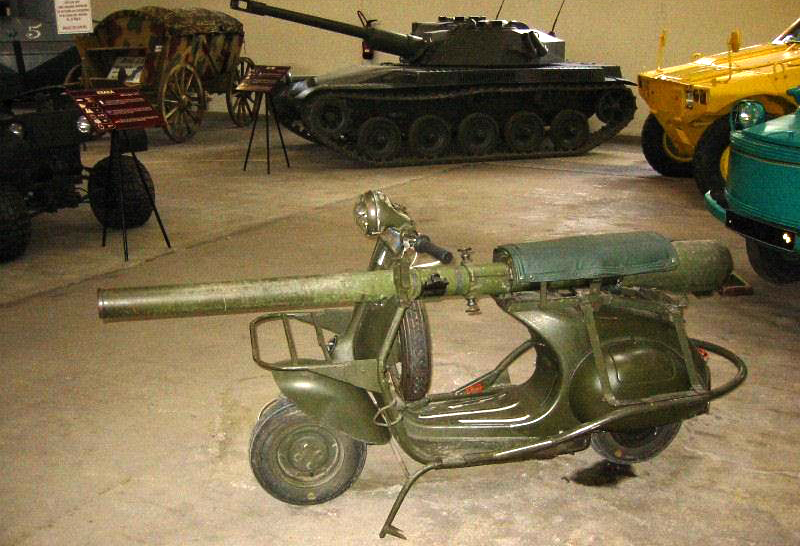
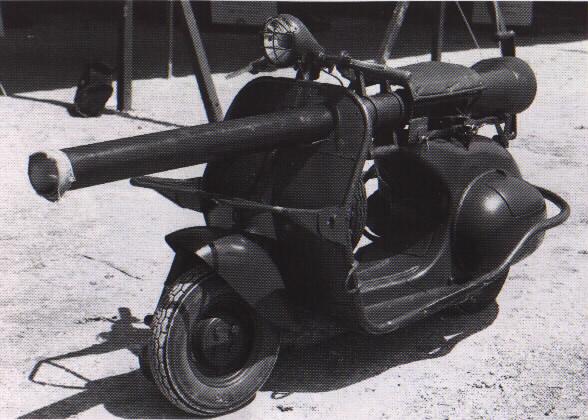
Armed Military Scooter

A scooter armed with a 75mm cannon....


After World War II, there was little money for defense spending while the nations of Europe rebuilt their industry and society. When there was some cash to spend, one had to be creative to stretch it as far as possible. The French probably accomplished the most astounding example of that with the
ACMA Troupes Aeról Portées Mle. 56. Deployed with their airborne forces, this was essentially a militarized Vespa scooter outfitted with a 75mm recoilless rifle. Five parachutes would carry the two-man gun crew, weapon, ammunition, and two scooters safely to earth, and the men would load the weapon on one scooter and the ammo on the other, then ride away. More impressively, the recoilless rifle could be fired effectively on the move by the best of the gun crews. Total cost? About $500 for the scooter and the recoilless rifle was war surplus. Were they successful military machines? Well, the French Army deployed about 800 armed scooters in wars conducted in both Algeria and Indochina."